CMOD Test to EN 14651: How Concrete Fiber Is Tested
Reinforce Global ·
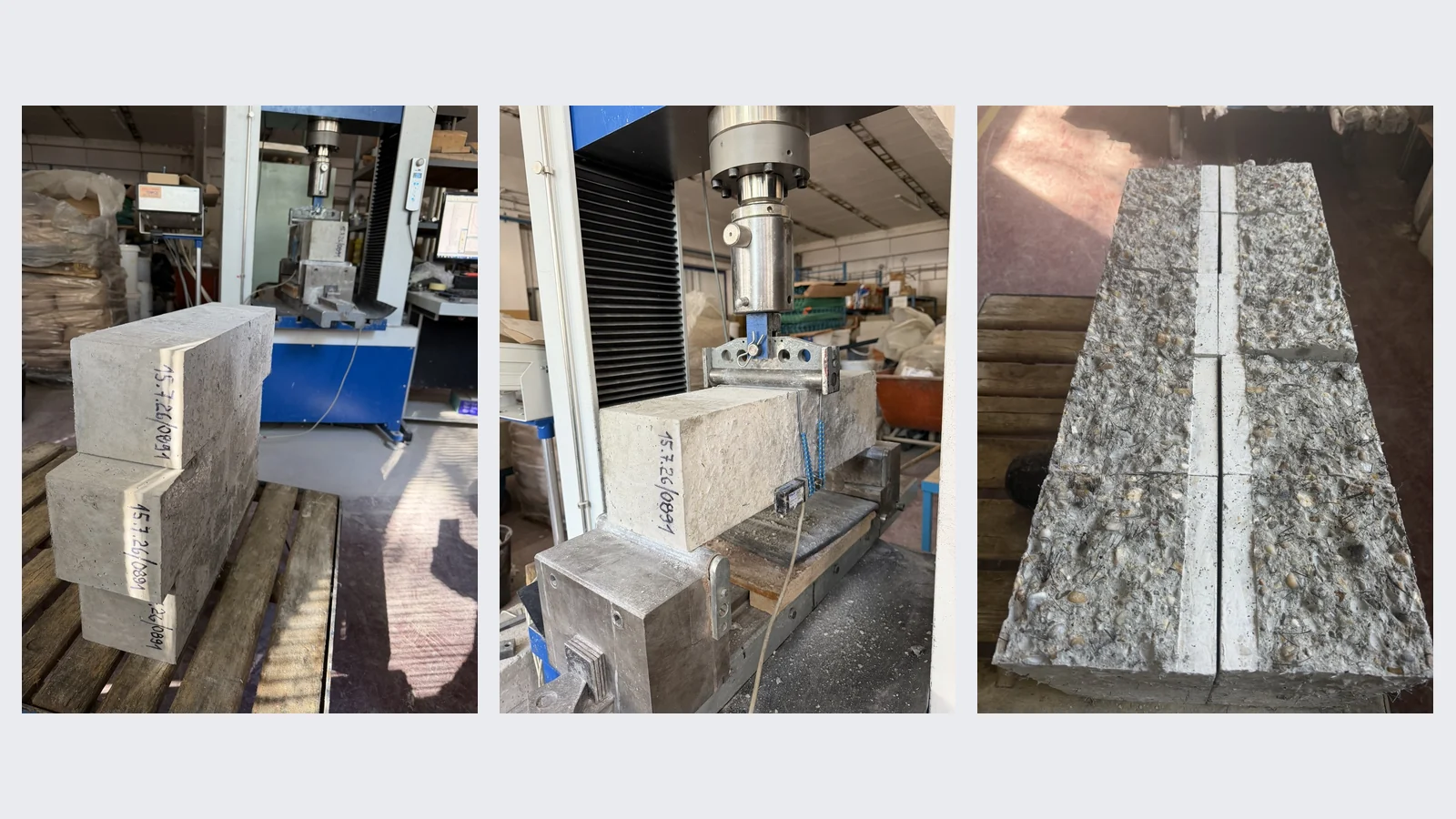
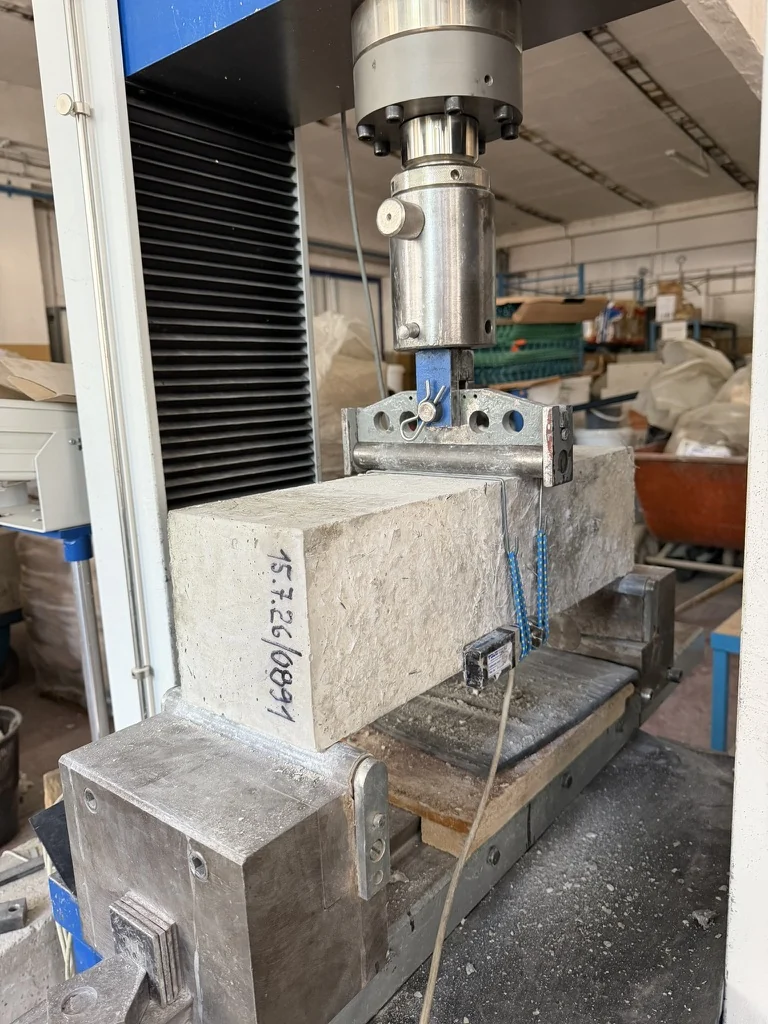
In summer 2026 we sent our polypropylene macro fibers ReinStrong and ReinFlex for testing at TSÚS in Bratislava, the Slovak Building Testing and Research Institute (Technický a skúšobný ústav stavebný) and an EU notified body. There, concrete beams were made with our fiber and broken in a press using the EN 14651 method. These tests are part of certifying our fiber to the European standard EN 14889-2.
Below are photos from these tests and a plain-language explanation of how the test works, what the fR1 and fR4 values in fiber technical data mean, and why a fiber without such testing should not be trusted.
Why fiber has to be tested
Concrete is strong in compression but weak in tension. Shrinkage, temperature changes or loads sooner or later cause a crack. Plain concrete simply opens up at that point.
This is exactly when macro fiber starts to work. The fibers cross the crack, are anchored in the concrete on both sides and keep the crack from opening. The concrete keeps carrying load even after the first crack.
The problem is that this behaviour cannot be seen by eye or in a standard compression test on cubes: fiber hardly changes the compressive strength of concrete. Two bags of fiber of the same weight can perform very differently in concrete: it depends on the material, thickness, length, shape and surface of the fiber, and on the dosage. That is why designers need measured values, not promises.
This is also why the European standard for polymer fibers, EN 14889-2, requires the manufacturer of a structural fiber (Class II) to declare the dosage that delivers a specified residual strength in concrete. This dosage is part of the Declaration of Performance (DoP) and the CE marking. For the buyer it is a safeguard: the dosage on the bag is backed by testing, not by guesswork.
What CMOD is
CMOD stands for Crack Mouth Opening Displacement. Put simply, it is how many millimetres the edges of the notch at the bottom of the beam move apart as the beam is bent. A dedicated gauge mounted across the notch measures it.
In this test, CMOD is used both to control the press and to read the results: residual strength is determined at crack openings of 0.5, 1.5, 2.5 and 3.5 mm.
How the EN 14651 test is carried out
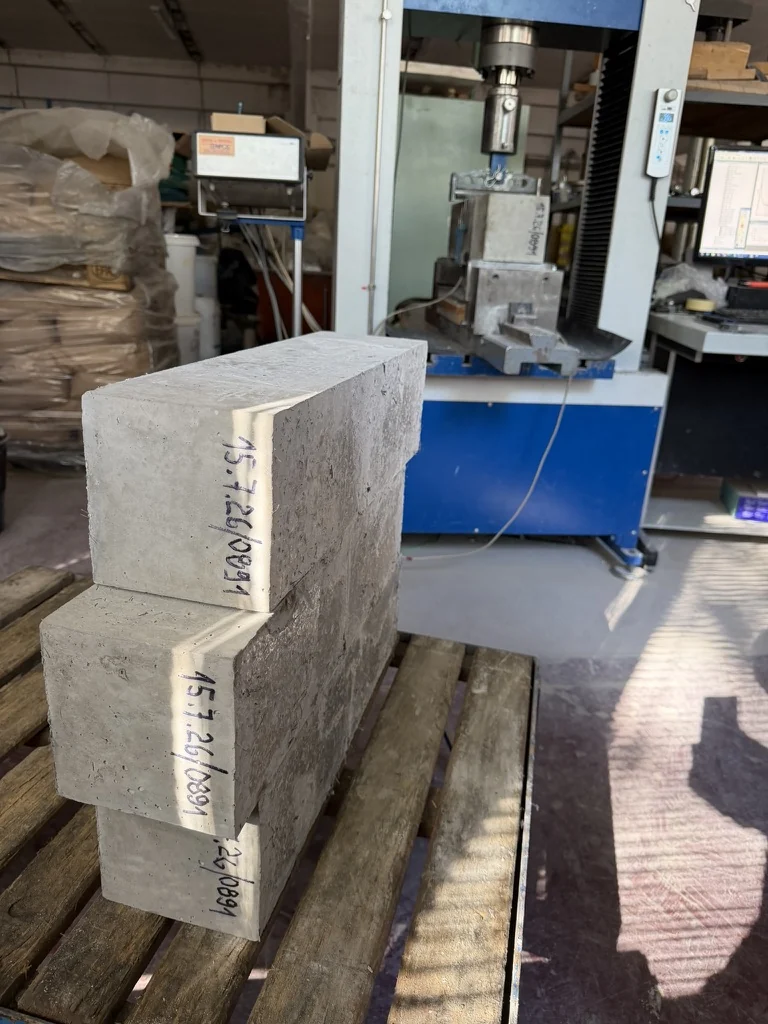
- Fiber concrete. A concrete mix is prepared with fiber at a given dosage. To compare the fiber itself rather than different concretes, a reference concrete to EN 14845-1 is used.
- Beams. The mix is cast into beams with a 150 × 150 mm cross-section and a length of 550 mm.
- Curing. The beams harden in moist conditions and are tested at 28 days.
- Notch. A 25 mm deep notch is sawn at mid-span on the underside of the beam. It fixes where the crack will form. Above the notch, 125 mm of concrete remains.
- Three-point bending. The beam is placed on two supports 500 mm apart and loaded from above at mid-span.
- Crack-opening control. The press loads the beam so that the crack opens at a constant rate: 0.05 mm/min up to a CMOD of 0.1 mm, then 0.2 mm/min. The test continues to a CMOD of at least 4 mm. A computer records load and crack opening throughout.
- Calculation. From the load–CMOD curve, the loads at crack openings of 0.5, 1.5, 2.5 and 3.5 mm are taken and converted into stresses.
The residual strength is calculated with the formula from the standard:
fR,j = 3 · Fj · l / (2 · b · hsp²)
Here Fj is the load at the given crack opening, l is the span between the supports (500 mm), b is the beam width (150 mm) and hsp is the height of concrete above the notch (125 mm).
One beam proves nothing. Each crack is crossed by a different number of fibers, so results from individual beams scatter far more than in a compression test. That is why a series of beams is tested and the mean and characteristic values are calculated.
What fR1, fR4 and the other values mean
| Value | Crack opening (CMOD) | What it shows |
|---|---|---|
| fL (LOP) | up to 0.05 mm | strength before cracking, provided mainly by the concrete itself |
| fR1 | 0.5 mm | fiber performance at a narrow crack: crack width control in service |
| fR2 | 1.5 mm | an intermediate point on the curve |
| fR3 | 2.5 mm | performance at a wide crack: ultimate limit state design |
| fR4 | 3.5 mm | performance at a very wide crack |
For structural polymer fiber, EN 14889-2 uses two points: the manufacturer declares the dosage at which the concrete reaches, on average, at least 1.5 MPa at a CMOD of 0.5 mm (fR1) and at least 1.0 MPa at a CMOD of 3.5 mm (fR4). Under the EN 14845-2 method, this dosage is confirmed on 12 beams. For example, the DoP dosage of ReinStrong that provides fR1 ≥ 1.5 MPa and fR4 ≥ 1.0 MPa is 4.5 kg/m³.
Designers who calculate fiber concrete to the fib Model Code 2010 use fR1 and fR3. Based on them, the concrete is given a class such as “2c”: the number is the characteristic fR1 in megapascals, and the letter reflects the ratio of fR3 to fR1, that is, how well the concrete carries load at a wide crack.
What the fractured beam shows
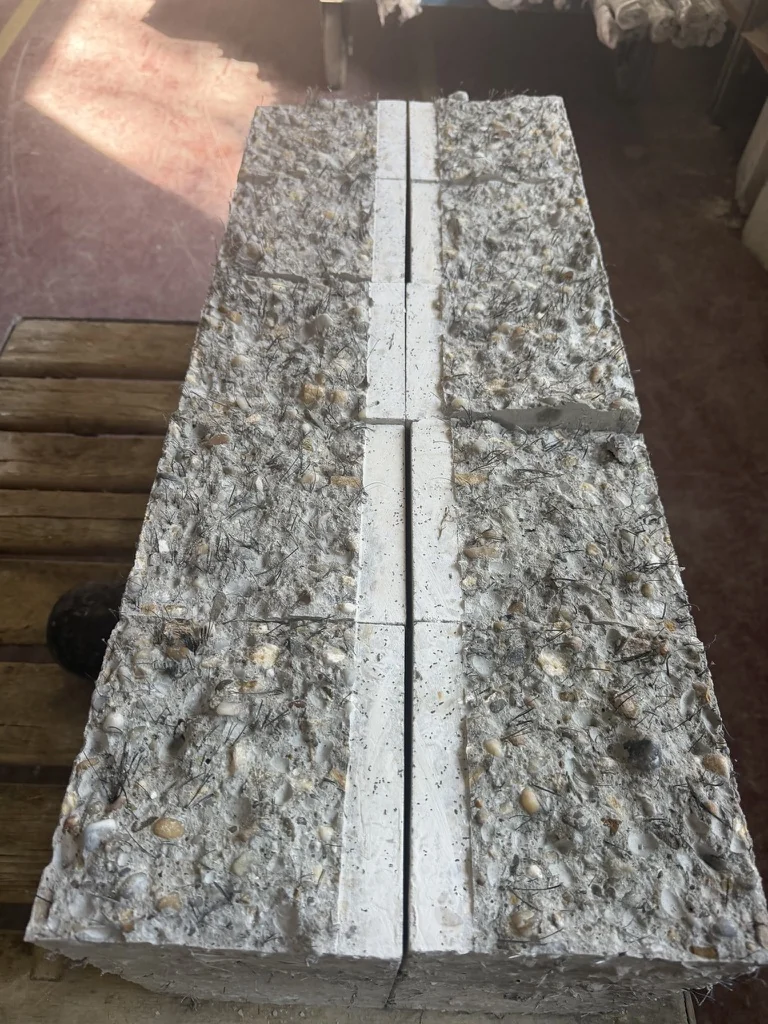
After the test, the beams are opened up and the fracture surface is inspected. The photo shows fibers sticking out of the concrete across the whole fracture surface. Each of them crossed the crack and was gradually pulled out of the concrete as the crack opened. This pull-out is what produces the load the press records after cracking.
Plain concrete without fiber breaks right after the first crack in this test, and the load drops almost to zero. Fiber concrete keeps carrying load. The more evenly the fibers are distributed and the better they bond with the concrete, the higher fR1 and fR4 are.
The fracture surface also shows how well the fiber was dispersed in the mix. If fibers have balled up, or there are hardly any in part of the surface, the result will be lower even though the dosage on paper is the same.
What this means for you
- Compare fibers by fR1 and fR4 at the same dosage, not only by price per kilogram. A cheaper fiber that needs twice the dosage ends up costing more.
- Ask your supplier for the DoP, CE marking and test reports. Without them, declared dosages are not backed by anything.
- For structures, the dosage comes from design. The designer takes fR values from the manufacturer’s declared data (DoP) and test results, and designs the slab for your loads.
We continuously monitor the quality of our fiber and test it at an independent laboratory so that the figures in our technical data match what you get in the bag. For help choosing a fiber for your task, see how to choose concrete fiber, and for the comparison with steel mesh, see fiber vs steel mesh for concrete floors. We are looking for distributor partners: contact us, and we will help with orders, dosage questions and delivery to your country.
In short: questions and answers
What is CMOD?
CMOD (Crack Mouth Opening Displacement) is how far, in millimetres, the edges of the notch at the bottom of a concrete beam move apart during a bending test. It is measured by a gauge mounted across the notch.
Which standard is used to test fiber-reinforced concrete in bending?
EN 14651. It is a bending test on a notched 150 × 150 mm concrete beam. For polymer fibers the method is applied through EN 14845-2, and the requirements for the fiber itself are set by EN 14889-2.
What do fR1 ≥ 1.5 MPa and fR4 ≥ 1.0 MPa mean?
They are the residual flexural tensile strength of fiber concrete after cracking: fR1 at a crack opening of 0.5 mm and fR4 at 3.5 mm. Under EN 14889-2, the manufacturer of a structural fiber declares the dosage that achieves at least these values on average over a series of beams.
Why is the beam notched?
The 25 mm notch fixes where the crack will form. This lets the gauge measure the crack opening precisely and makes results comparable between beams and between laboratories.
Where was Reinforce fiber tested?
In summer 2026, our polypropylene macro fibers ReinStrong and ReinFlex were tested at TSÚS in Bratislava, Slovakia, a building testing institute and EU notified body.