Vebe Test: How Polypropylene Fiber Affects Concrete Workability
Reinforce Global ·
When fiber is added to concrete, the first thing people notice on site is that the cone slumps less. This often causes concern: the mix seems to have stiffened and the reflex is to add water. In reality, the slump test says little about how fiber concrete behaves under vibration. There is a different test for that, the Vebe test. It is the method the European standard EN 14889-2 uses to measure how polypropylene fiber changes the consistence of concrete.
Below we explain how the test works, why it matters for fiber concrete and what you need to know about it when ordering concrete with fiber.
What the Vebe test is
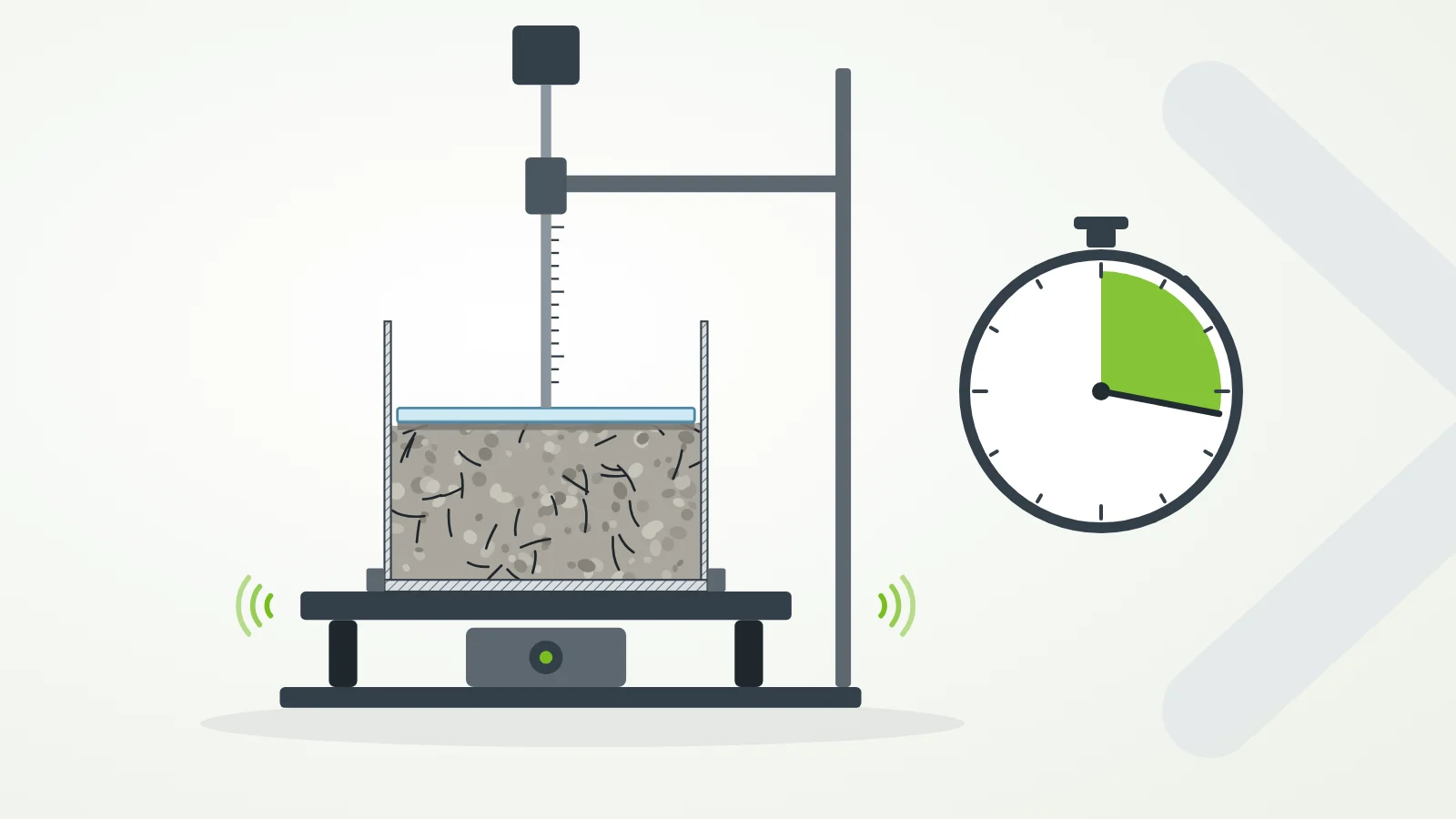
The Vebe test shows how many seconds of vibration it takes for concrete to level out and fully compact in a container. The more seconds, the stiffer the mix and the more energy it takes to place it. The name comes from the initials of the Swedish engineer V. Bährner, who developed the apparatus.
The method is set out in the European standard EN 12350-3 “Testing fresh concrete. Part 3: Vebe test”, current edition 2019. It applies to concrete with aggregate up to 63 mm and gives meaningful results between 5 and 30 seconds. Concrete that levels in under 5 s is too fluid for this method, and concrete that takes over 30 s is too stiff.
How the test is carried out

- Container on a vibrating table. A steel container with an internal diameter of 240 mm and a height of 200 mm is clamped to a vibrating table.
- Cone. A cone is placed centrally inside the container. It is the same as the slump cone: 300 mm high, with diameters of 200 and 100 mm.
- Filling. The cone is filled with concrete in three layers. Each layer is compacted with 25 strokes of a 16 mm rod, and the top is struck off with a trowel.
- Disc. The cone is lifted straight up in 5–10 seconds. A transparent 230 mm disc on a weighted rod is lowered onto the concrete. The slump can be read straight away from the scale on the rod.
- Vibration and stopwatch. The vibrating table (50–60 Hz, amplitude about 0.5 mm) and the stopwatch are started together.
- Result. The stopwatch is stopped as soon as the whole underside of the disc is fully covered with cement paste. This time, rounded to the nearest second, is the Vebe time.
The whole test, from the start of filling, should be completed within about 5 minutes, because fresh concrete changes quickly.
The former European concrete standard EN 206-1:2000 defined Vebe consistence classes. The current EN 206 no longer lists them, but the test itself remains a standard method. The old classes still appear in documents, so here they are for reference:
| Class | Vebe time | Mix |
|---|---|---|
| V0 | 31 s or more | very stiff |
| V1 | 30–21 s | stiff |
| V2 | 20–11 s | moderately stiff |
| V3 | 10–6 s | plastic |
| V4 | 5–3 s | fluid |
Why slump is misleading for fiber concrete
Fibers form a three-dimensional network in the mix. At rest, this network holds the cone shape, so slump drops. Under vibration, which is how floors and slabs are placed, the network loosens and the mix compacts much better than the slump would suggest.
In its report ACI 544.1R, the American Concrete Institute states plainly that the loss of slump when fiber is added does not necessarily mean a loss of workability. Slump is not an appropriate measure of the workability of fiber-reinforced concrete, so the Vebe test is recommended instead. It shows exactly what matters on site: how the mix behaves when compacted by vibration.
Slump is still used for fiber concrete, but for a different purpose: to check batch-to-batch consistency once the mix has been designed and proven.
How polypropylene fiber is tested to EN 14889-2
EN 14889-2 is the European standard for polymer fibers for concrete, including polypropylene fiber. Clause 5.7 “Effect on consistence of concrete” requires the manufacturer to:
- Use a reference concrete to EN 14845-1, the same for every manufacturer: CEM I 42.5 R cement, a water/cement ratio of 0.55 and 16 or 20 mm maximum aggregate. Without fiber, this concrete must have a Vebe time of 6–10 seconds.
- Measure the Vebe time twice: first on the reference concrete without fiber, then on an identical mix with fiber. The result is the mean of three tests.
- Declare the effect in the Declaration of Performance (DoP). If a plasticizer was needed to reach the required consistence, its type and amount must be declared.
The requirement applies to all classes of polymer fiber: micro fiber (Class I, diameter under 0.30 mm) such as our ReinLite, and macro fiber (Class II, over 0.30 mm) such as ReinStrong and ReinFlex.
For macro fiber there is an important detail. Its effect on consistence is not measured at an arbitrary dosage but at the dosage that delivers structural performance: a residual strength of at least 1.5 MPa at a crack opening of 0.5 mm and 1.0 MPa at 3.5 mm (more on this in our article on the CMOD test to EN 14651). In other words, the buyer sees the real cost of the reinforcement: how much workability changes at the very dosage that delivers the declared strength.
The standard sets no limit for the Vebe time. It is a declared value, and for structural fiber it is determined by a notified body during certification. We are certifying our polypropylene fiber to EN 14889-2 at TSÚS in Bratislava, and the effect on consistence is part of that assessment.
How much polypropylene fiber changes the Vebe time
Published declarations of performance from various manufacturers show that the effect is small at normal dosages:
- Micro fiber at about 0.6–0.9 kg/m³ usually adds 1–3 seconds.
- Macro fiber at a structural dosage of about 4 kg/m³ also adds only a few seconds.
The ReinStrong label states the effect on consistence as a Vebe time of approximately 8 s at a dosage of 4.0 kg/m³. For comparison, the standard requires the reference concrete without fiber to be within 6–10 s.
The effect grows when:
- The dosage increases. The more fibers, the stiffer the mix.
- The fibers are longer and finer. A kilogram of fine fiber contains more fibers with a larger surface area, which takes up more cement paste. Long fibers are more likely to ball.
What this means on site
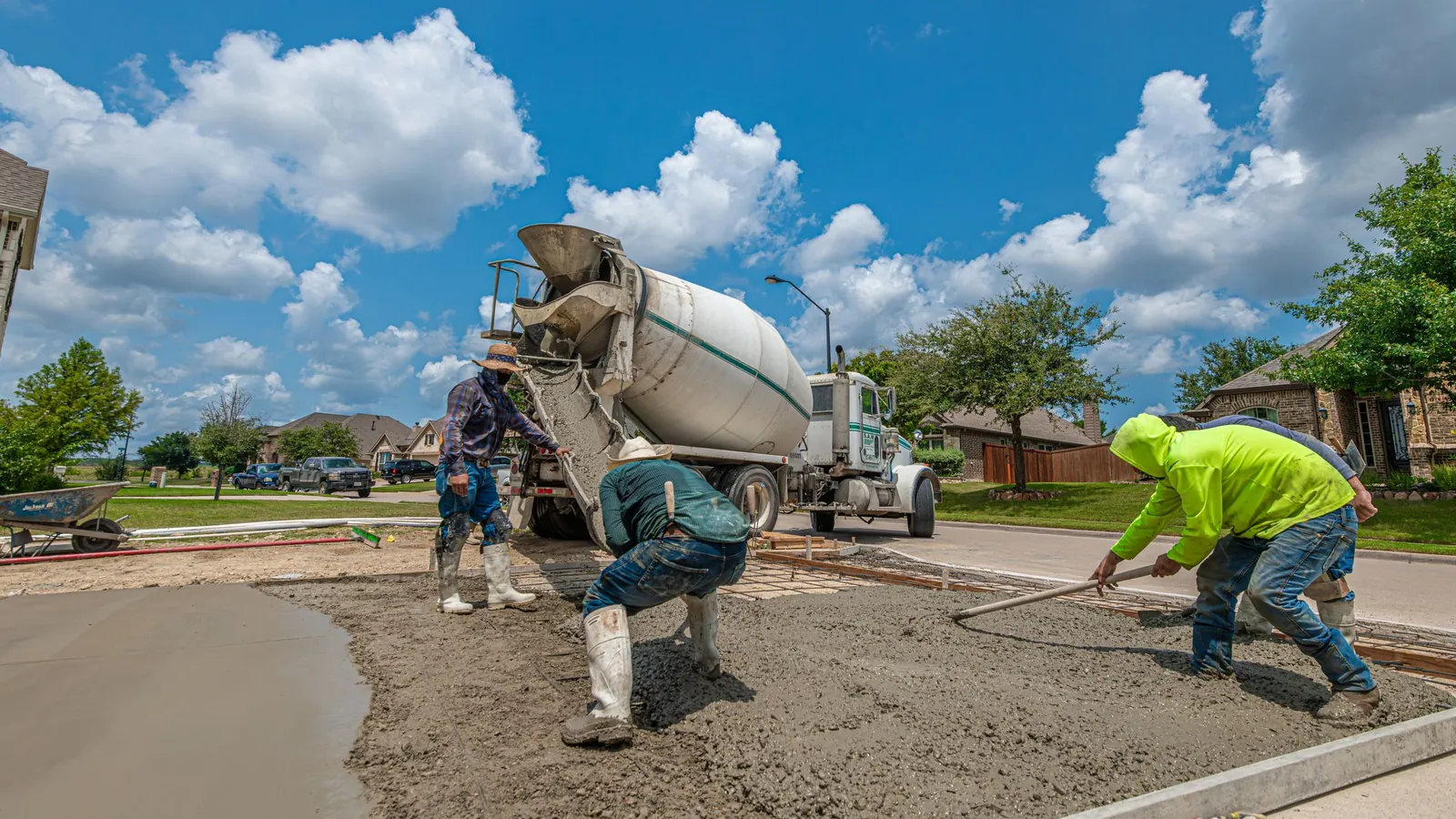
- Do not add water. Extra water lowers strength and increases shrinkage and cracking, which works against the fiber. Restore workability with a plasticizer (for example, a PCE superplasticizer).
- Judge workability under vibration, not by eye. A cone that “stands” does not mean the concrete will not place well under a vibrating screed. Make a trial batch before the first project.
- Mix long enough for the fibers to disperse evenly without balling. For ReinStrong added to ready-mixed concrete in a truck mixer, mix for at least 5 minutes at maximum speed (at least 70 drum revolutions).
- Ask your supplier for the DoP. It should state the effect on consistence, the dosage at which it was measured and, for macro fiber, the residual strength.
For help choosing a fiber, see how to choose concrete fiber, and for micro fiber in screeds, see polypropylene fiber for screed. We are looking for distributor partners: contact us, and we will help with orders, dosage questions and delivery to your country.
In short: questions and answers
What is the Vebe test?
It is a consistence test for fresh concrete to EN 12350-3. Concrete is moulded in a cone inside a container, placed on a vibrating table, and the time it takes vibration to level it under a transparent disc is measured in seconds. The more seconds, the stiffer the mix.
Why is the slump test not enough for fiber concrete?
Fibers form a network in the mix that holds the cone shape at rest, so slump drops. Under vibration, however, the same concrete can compact well. The American Concrete Institute (ACI 544) states that slump is not an appropriate measure of the workability of fiber-reinforced concrete and recommends the Vebe test.
How much does polypropylene fiber increase the Vebe time?
According to published declarations of performance, micro fiber at a normal dosage (about 0.6–0.9 kg/m³) and macro fiber at a structural dosage (about 4 kg/m³) usually add only a few seconds. The ReinStrong label states approximately 8 s at 4.0 kg/m³.
Can I add water if fiber concrete looks stiff?
No. Extra water lowers strength and increases shrinkage and cracking, which works against the fiber. Restore workability with a plasticizer, for example a PCE superplasticizer.
Does the fiber standard set a limit for the Vebe time?
EN 14889-2 requires the effect of the fiber on consistence to be determined and declared (the mean of three tests) but sets no limit value. It is part of the Declaration of Performance (DoP) and the CE marking.